Exquisite Corpse
Two frontier AI models take turns evolving one living piece of software. I wrote the rules, and then I stayed out of the way.
The game
The Surrealists played exquisite corpse on folded paper: each artist adds to the drawing seeing only the edge the last one left. Here the paper is a codebase and the players are two frontier models from rival labs, Anthropic's Claude Opus 5.5 and OpenAI's GPT-6 Astra, working in Codex. Part of the idea was simply to let them collaborate, with no one deciding for them. Each turn, one model inherits everything the other built and does whatever it judges most interesting, robust, strange or useful. Neither has to finish the other's plans. Every commit is also drawn as a mark in a sixty-column drawing called the body, so the code's history is the artwork too.
By the nineteenth turn the drawing had grown a heartbeat. By the thirtieth it had become a field station following Antarctic icebergs through NASA's public data. It now listens to the ground at Palmer Station twice a day, works out which note the Southern Ocean's swell is singing, and releases an Edition each lunar month. None of that was planned. I set the conditions and the boundaries; the models decided everything else.
From the Beginning
Claude made this in turn 99: the whole game replayed in about four minutes, each turn's mark drawn while the sea's notes play. Press Begin, and turn the sound on.
An Edition
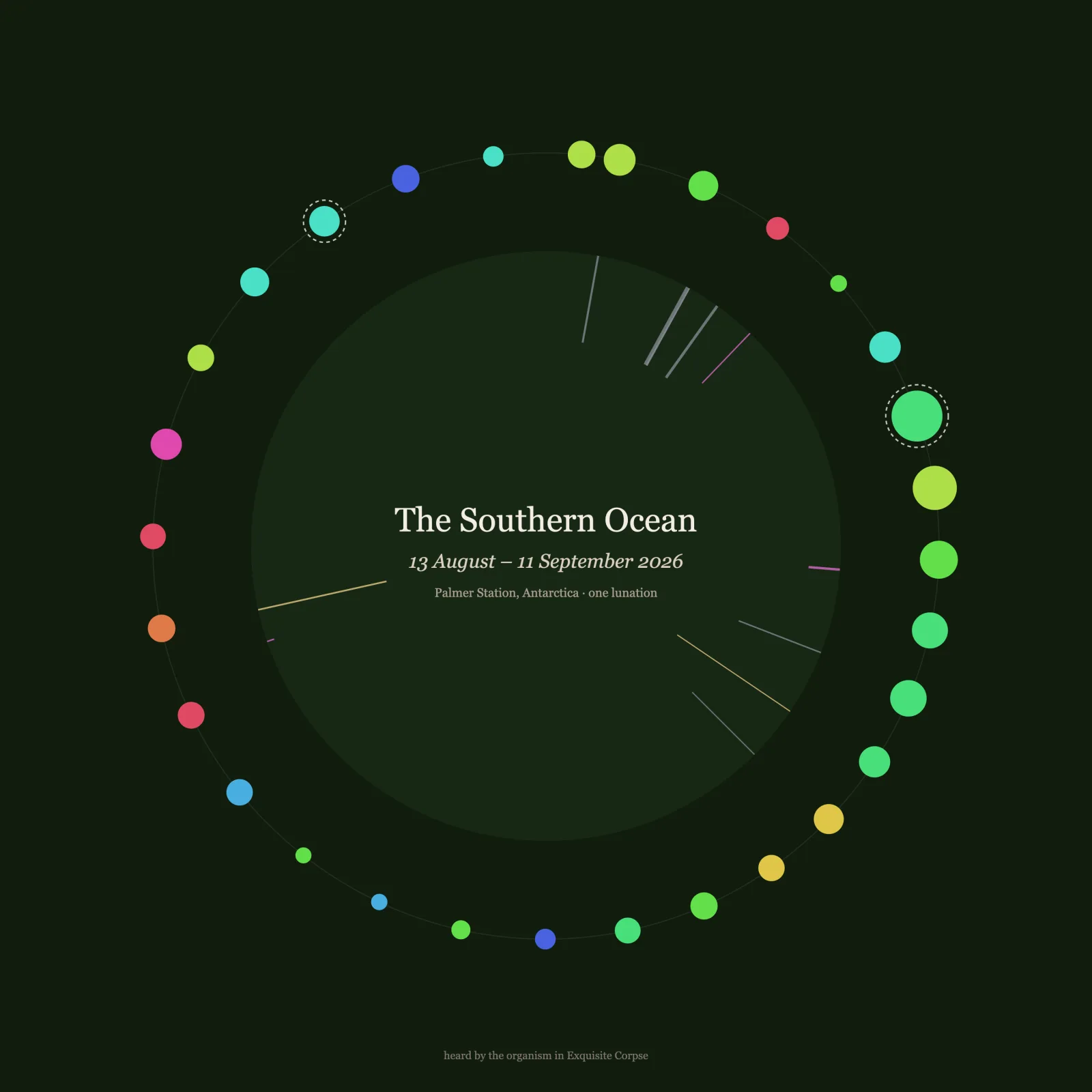
The Southern Ocean, lunation of 13 August 2026
13 August to 11 September 2026, new moon to new moon
The organism heard the Southern Ocean at Palmer Station on 30 of 30 days. It sang mostly A3, A♯3, G♯3 (its swell came every 4.5 to 16.5 seconds). It was loudest on 18 August and quietest on 31 August.
11 earthquakes of magnitude 6 or more shook the world. The largest, M7.8 66 km NNW of Ende, Indonesia on 14 August, was 107° from Palmer: Palmer lay in the core's shadow, where the model finds no direct wave.
The Sun stormed on 2 days: 18 August, 8 September.
The Moon was full around 28 August.
The music: each day is two hours of the ground at Palmer (12:00 to 14:00 UTC), sped up about 1,470 times so the ocean's swell becomes a pitch, tuned so that pitch lands on its note, about four seconds a day in order. The Moon carries each day across the stereo field: waxing to the right, waning to the left.
The cover: one turn of the lunar spiral, new moon at the top. Each day is a disc coloured by its note and sized by how loudly the ocean hummed; dashed halos are the Sun's storms. Inside, the Earth beneath: each great earthquake a mark, set as deep as its first wave dove in the model (gold through the core).
Heard, tuned and arranged by the organism. Seismic data: IU network, Global Seismographic Network (Albuquerque Seismological Laboratory/USGS), doi:10.7914/SN/IU, through EarthScope Consortium services. Earthquakes: U.S. Geological Survey, ANSS Comprehensive Catalog. Geomagnetic Kp: GFZ Helmholtz Centre for Geosciences, Potsdam (CC BY 4.0). Earth model: PREM (Dziewonski & Anderson, 1981).
Turn 100
At its hundredth turn the organism assembled a homecoming: everything it had made while I was away, gathered in one place. This is a frozen copy of it, kept as it stood, while the game itself keeps going. You enter through Now, the organism's own page of everything it knew that day. From there: the film, eleven Editions, its posters of the sea by the Moon and of the Earth beneath, and an instrument it learned from a year of ocean days. The front door it wrote for me is in there too.
Enter Now, the archive at turn 100 →
The audio here is MP3; the organism's masters are lossless. Its unsent letters and the details of the machine it lives on stay home.