BAD ACID
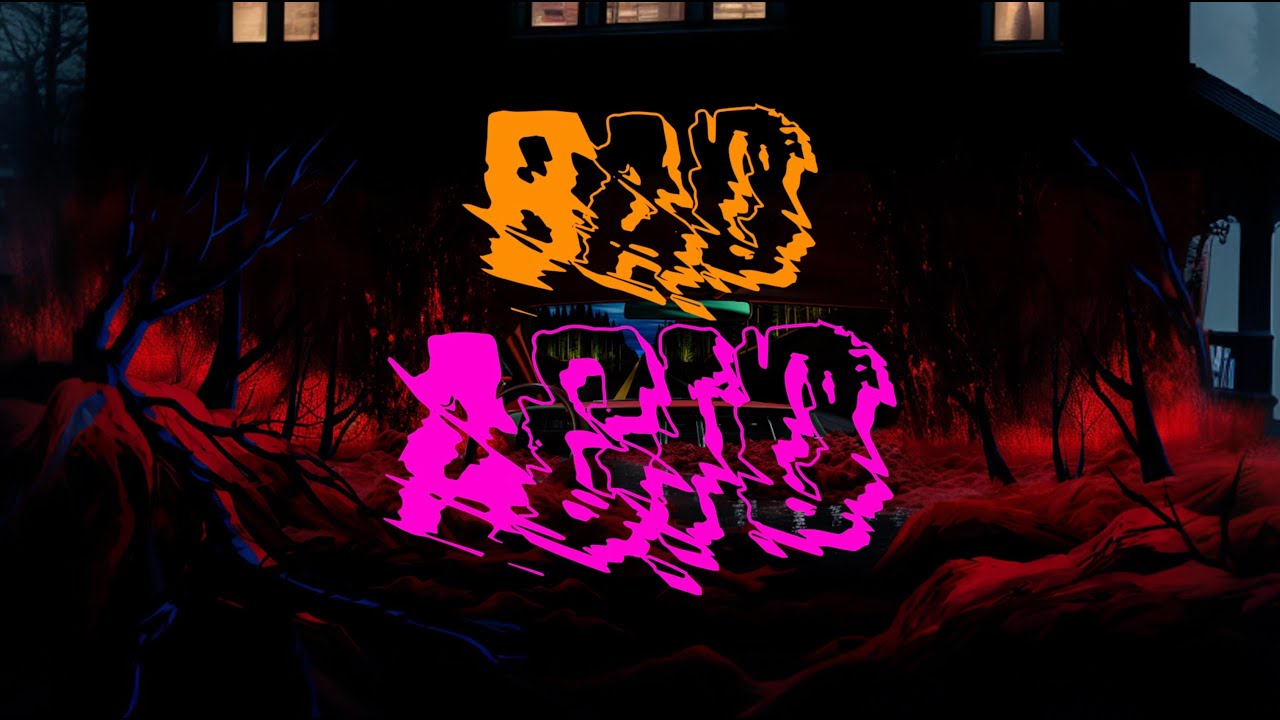
A man drives to a cabin to take acid and meet himself. The camera follows him in. Then the AI takes over.
The Brief
The 48 Hour Film Project is exactly what it sounds like: write, shoot, score, and finish a film in a single weekend. Every team draws a genre from a hat and receives the same three required elements, a character, a line of dialogue, and a prop, that must appear in the finished piece.
I went in with a plan and a constraint of my own choosing: work completely alone, and use the 48 hours to push everything I'd been learning about generative tools into a single finished piece. The generative models of 2023 were limited, but I'd tested them enough to know one thing for certain. They were extraordinarily good at unreliable, trippy, unsettling imagery. So I was hoping to draw horror or sci-fi. I drew horror.
The required elements were the same for every team: a character named Bobby the truck driver, the line "ask yourself one question: do I feel lucky?", and the prop, adhesive tape.
The Concept
The story arrived almost immediately, because the technology suggested it. A man goes off to a cabin in the woods to take acid alone, an attempt at introspection. The horror comes from what he finds looking back at him. The film's structure mirrors its own production: it opens in traditional filmmaking, clean digital footage shot on a Panasonic S1, with the walk through the forest captured on a Kandao 3D/360 camera for a more immersive, unmoored feeling. As the trip takes hold, it dissolves into fully generative imagery. The medium becomes the descent.
Bobby, the mandatory character, became the externalization of the protagonist's deepest fears about himself. Left to my own devices I might have cut that requirement entirely, but watching it back years later, the forced element is one of the most genuinely menacing things in the film. The constraint made it stranger than I would have made it alone.
The Pipeline
There was no single AI tool that could make this film. The work was matching each tool to the specific emotional job it was best at, and building a production line that could run inside a weekend.
Midjourney · Infinite Zoom
The opening and closing sequences use Midjourney's outward-zoom feature to generate an endless receding image, the frames then arranged and composited in After Effects. It frames the whole film like a pupil dilating open and closed.
Deforum + Stable Diffusion + LoRA
The peak of the trip is animated with Automatic1111, Deforum, and Stable Diffusion, driven by a body-horror LoRA, a deliberate nod to John Carpenter and the practical body horror of the '80s. This is where the film stops looking shot and starts looking summoned.
Runway + Kaiber · Style Transfer
Video-to-video style transfer applied to my own footage: turning real performance into psychedelic hallucination, and morphing me, the actor, into Bobby. The vid2vid layer that carried the transformation between the real and the rendered.
ElevenLabs + ChatGPT · Voice
A disembodied female podcast host threads through the film, her script written with ChatGPT, her voice synthesized in ElevenLabs. A calm, generated narrator for an increasingly ungovernable image.
Color Inversion & Grade
Aggressive color correction and inversion pushed the generative passes into ominous psychedelia. At its peak it tips into a horror-tinged echo of the Star Gate sequence from 2001: A Space Odyssey.
Original Synth Score
No AI in the audio. Written and performed on synths in the lineage of Carpenter's Halloween: spare, analog, and built for one purpose: dread.
Human in the Loop
These animations were expensive: long, heavy renders where a single sequence could run hundreds of frames. You cannot brute-force that in 48 hours. I started the Deforum pieces Friday night, the most processor-intensive work in the whole film, and let them cook overnight. They were well worth the wait. The craft was in the direction of the machine: choosing the right first frame, testing a handful of frames to read the motion and the mood, and only then greenlighting a full run. Every generation was art-directed before it was rendered.
To make the clock work, I ran a small render farm of one: my self-built desktop grinding on one thread, Deforum running in parallel in the cloud, and my MacBook Pro handling the edit. Three machines, one operator, working simultaneously so no hardware ever sat idle. It was as much a logistics problem as a creative one.
I never really fought the tools. I knew going in that all of this would be a little wonky in 2023, so instead of sanding down the artifacts I leaned into them. The flicker, the melting, the surreal drift between frames were not bugs to hide. For a film about a bad trip, that instability was the point. Directing the tools meant knowing which weirdness served the horror and steering toward it, not away.
Sound as Structure
Beyond the score, the sound design does structural work. Every audio choice is there to make the visuals land harder, to tell you how to feel about an image the models rendered without intent. When the picture is unstable, the sound has to be the thing that means something.
What Holds Up
Watching it back, the honest assessment: the Runway-era style transfer has aged the most, and 2023 vid2vid carries the fingerprints of its moment. But the Stable Diffusion animation and the Midjourney infinite zoom still hold, and I think that's the real lesson. They hold not because the models were good by today's standards, but because they were pointed at something: fear. Generative work survives when it's doing emotional work, not when it's showing off the tool.
Why It Matters
BAD ACID is a proof of a specific way of working: taking a creative brief and, under real constraint, assembling the right generative tools into a production pipeline that ships finished, art-directed, award-winning work. Not prompting for a lucky output, but directing a stack of models toward a feeling, and knowing where the human has to stay in the loop for the result to mean anything. That's the skill: translating vision into a repeatable generative workflow, and making the technology serve the story instead of the reverse.